
The No Strategy Approach
You don't need a better strategy, you need a different playbook.

“Insanity is doing the same thing over and over again and expecting different results.”
Rita Mae Brown
The paradox of modern management: a cult of data-driven decisions and, at the same time, a blind faith in a method that has never actually been proven to work.

Inside the Club today:
1. Monkeys and “we’ve always done it this way”
2. Five deadly sins of traditional strategy
3. Strategy as a folk remedy for back pain
4. A much simpler yet still effective approach
5. CEO Uncomfortable Questions
Monkeys and “we’ve always done it this way”
Imagine a cage with five monkeys and a ladder leading to a bunch of bananas. Every time a monkey tries to climb up for a snack, the scientists drench the other four with ice-cold water.
The monkeys soon get the hint. Before long, anyone even looking at that ladder gets a collective beatdown.
Then, the researchers swap one of the old-timers for a rookie. The new guy sees the bananas, goes for the prize, and—BAM!—gets beaten up by the group.
He retreats to the corner, nursing his bruises and utterly confused about what he did to deserve that.
Then the scientists replace other monkeys, one by one. Eventually, you’re left with five monkeys who have never felt a single drop of cold water in their lives. Yet, they continue to savagely stomp on anyone who dares to touch the ladder.
You won’t find any monkeys in a boardroom. But you’ll still see people getting shut down just for straying from ‘the way we’ve always done things here.’
Many walls stand between us and new knowledge, but the tallest is built by our own experience. Knowledge lives as long as there is doubt; but once forged in experience, it becomes an axiom.
Strategy theory has become such an axiom. It’s high time to challenge it. After all, this is a club for thinkers, not corporate monkeys.
Five deadly sins of traditional strategy
Some medieval mystics tried to define God through negation. Their logic was simple: by stripping away what God is not— a person, light, or an object — they hoped to find the Truth.
Modern strategy discourse, ranging from academic scholars to the self-proclaimed wisdom of LinkedIn, has also enlightened us as to what strategy is not. We’ve learned that it’s not a plan, a 200-page deck, or a goal. A pity, then, that we haven’t been as lucky in discovering what it actually is.
It’s not that theorists haven’t tried. But the results are grim: up to 90% of strategies still fail.
If an elevator fails to get you to your floor 9 times out of 10, wouldn’t it be smart to take the stairs?
I could write volumes on the flaws of traditional strategy theory. But I value your time, so I’ll stick to the essentials.
1. Treating strategy as a mere “set of choices.”
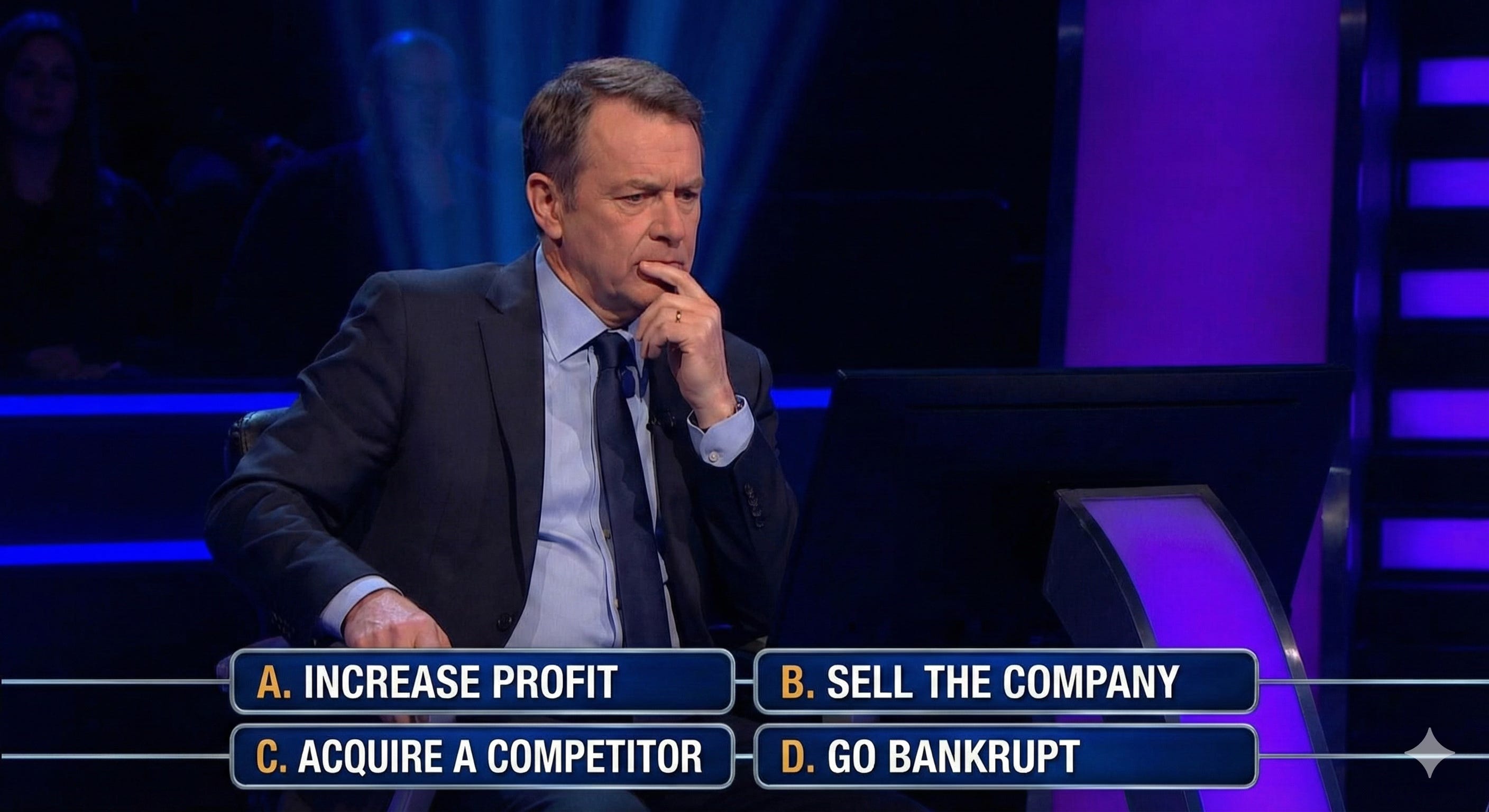
They’ve told us that ‘strategy is a set of choices.’ This implies—explicitly or implicitly—that there is a finite list of options, and our only job is to pick the right one. But business isn’t Who Wants to Be a Millionaire?
Strategy is about creation, not just selection. We must create new value for our customers, employees, and partners. By doing so, we earn the chance to create value for our shareholders, too.
If a CEO is merely picking the best ‘strategic initiative’ from a list of options, they’re like an actor selecting a role. If you want to be a legendary CEO, write the script.
Seeing strategy as a “set of choices” drags us back to the 1980s—to the idea of a “market” that we must “win.” But as we’ve discussed before, we should ditch the term “market” altogether. The goal of a business is to create a customer—or better yet, a Patron.
2. Measuring success by adherence to the plan.
Unpopular opinion: If everything went exactly according to plan, you’ve made a mistake somewhere.
Today, the standard way to judge a strategy is to compare results against the original plan. To me, if they match perfectly, it’s a disaster.
It means neither the strategy nor the company has evolved along the way. The leaders acted as “corporate monkeys”—experts at moving the needle, but too busy to look up and reflect.
3. Centering the strategy on the business instead of the customer.
Roger Martin recently defined strategy as making choices to change customer behavior for the firm’s benefit.
My reaction? Facepalm.
A perfect definition for a $25 online course titled: ‘How to Milk Your Customers Dry.’
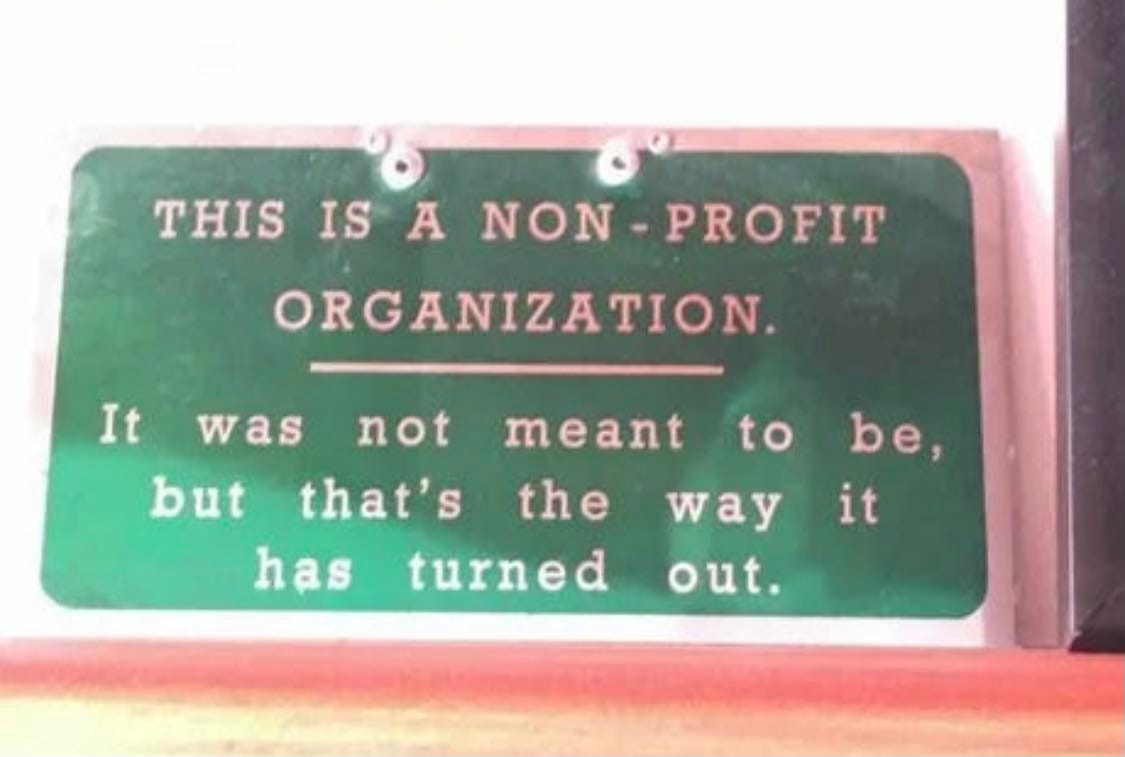
Profit isn’t a goal. It’s a ‘performance bonus’ customers award you for your hard work of creating value.
When leaders write with their left hand that they aim to ‘make the world a better place,’ while their right hand is busy chasing market cap, they suffer from a severe case of corporate schizophrenia.
4. Hallucinating a predictable path from A to B
No matter what theorists write about strategy, they always mean the same: strategy is a path from A to B.
But anyone living in the real world—rather than the imaginary universe of Roger Martin’s namesake, George R.R. Martin—knows that predicting where B is, let alone how to get there, is a total hallucination.
Compared to this, ChatGPT’s cute little errors are child’s play.
5. Assuming strategy is a proven science
And, finally, no one has ever proven that strategy works. Yes, I mean that.
The cherry-picked studies so beloved by HBR don’t count. They are usually written by people whose toughest decision in life has been choosing which wine to pair with dinner.
Besides, there isn’t a shred of evidence that guys like Steve Jobs, Jeff Bezos, or Elon Musk ever used a SWOT analysis or a BCG matrix to build their empires.
Strategy has become the corporate equivalent of a folk remedy for back pain: it has never been clinically proven, but everyone believes it works, so they keep using it.
Are you ready to try something new?
A much simpler yet still effective approach
You don’t need a strategy. You need to think and act strategically.
At its core, strategy is simply an agreement between you and your team about what you do—and, more importantly, what you don’t.
If your business is small, this agreement can be jotted down on a napkin over a beer. If it’s bigger, you need some kind of document.
What if I offered you a much simpler yet still effective approach?
1. Using directions instead of strategic goals
Forget strategic goals. They do more harm than good.
Pick a direction for your business to grow. Base it on your mission and the Big Customer Problem you’re here to solve.
For instance: We grow by building and refining [your core products] for [your core customers] to solve their [Big Customer Problem] in [your target markets].
Sound like a slogan? Perhaps. But “achieving market leadership in the rubber duck industry by 2028” sounds like a pipe dream.
2. Determining the pace of change instead of meeting artificial KPIs.
I recommend setting the pace of growth—say, 20% per year—but stay flexible if you move slower.
Quality over quantity. If you need to slow down or even stop for a while—do it.
Chasing a fixed goal often means pursuing a fantasy that may have nothing to do with reality.
I’m not saying you must banish goals entirely. But if you do use them, keep these three traps in mind:
No matter how ambitious the goal, you might be capable of more. But if you set a fixed goal—say, 20% per year—you subconsciously shut out opportunities for 50% growth.
Rigid goals create rigid businesses.
If everything went exactly according to plan, you’ve made a mistake somewhere.
When you use a direction instead of a goal, and stop seeing targets as vows, you keep more doors open.
3. Using Big Customer Problems instead of Winning Aspirations
Starting with ‘winning aspirations’ creates ‘me-me-me’ strategies.
Stop dreaming about how much money you’ll earn. Start thinking about how much value you can create for your customers—the profit will follow naturally.
Compare two versions of a corporate vision:
A. We’ll become an international leader in [Industry] by 2030.
B. We’ll solve [Big Customer Problem] for [X] million people by 2030 and build a high-growth business around that impact.
Which one will work better?
4. Using Assets and Processes instead of ‘strategic initiatives’
Many strategies rely on lists of ‘strategic initiatives.’ This approach can certainly work, but I find a more direct path often gets us there faster.
I like to focus on one core question: ‘Which assets and processes should you change or build from scratch to deliver value and solve the Big Customer Problem?’
5. Using Navigational Principles instead of pre-set decisions
Instead of trying to decide everything in advance, my clients set principles that let them make the right calls day after day.
Which customers do we prioritize?
Which products do we develop first?
Who do we hire?
Which processes do we automate?
Strategic principles are answers to 30–40 questions like these—the ones that let leaders across the company make day-to-day decisions.
CEO Uncomfortable Questions
Do your key people know exactly which Big Customer Problem you are solving?
How often are you forced to move the goalposts? If you’re constantly revising your strategic goals, is the constant rewriting actually worth the effort?
Do you have Navigational Principles that empower your team to make the right calls every single day?
Are you crystal clear on which Assets and Processes you must build or fix first?
Conclusion: Customer-Axis Framework
The No Strategy Approach is part of my Customer-Axis Framework. It’s the result of my real-world mileage: 13 years leading as a CEO, 12 years serving on boards, and a decade spent in business consulting.
This approach has been proven across dozens of successful projects worldwide. Its power lies in its clarity and elegant simplicity—an antidote to the over-engineered strategies that usually just collect dust.
It’s built on a few core principles:
The customer is your only source of revenue and growth. Period. This means the primary goal of any business is to create a customer—or what I call a Patron.
Growth isn’t a project; it’s a process. You don’t “do” growth once a quarter. You create and refine customer value every single day.
Any decision that helps you deliver more unique value to your Patrons and stakeholders is strategy.
My definition of strategy: Strategy is a set of coordinated actions to maximize value for all stakeholders, including customers and shareholders.
It’s as simple as that.
Every Tuesday, I share how the Customer-Axis Framework can make your business stronger. Stay tuned!
Next Tuesday, I’ll share how processes fuel your Growth Metabolism.
This reframes strategy not as a rigid plan or a set of initiatives, but as a flexible, customer-focused playbook guided by direction, principles, and value creation rather than fixed goals
This is great. I often say the sign of a good strategy is it's not a simple truism. If someone doesn't disagree with your strategy, it's not actually an interesting insight.