
The CEO’s Firefighting Trap
The real issue isn’t volume of problems, but how your organization absorbs them

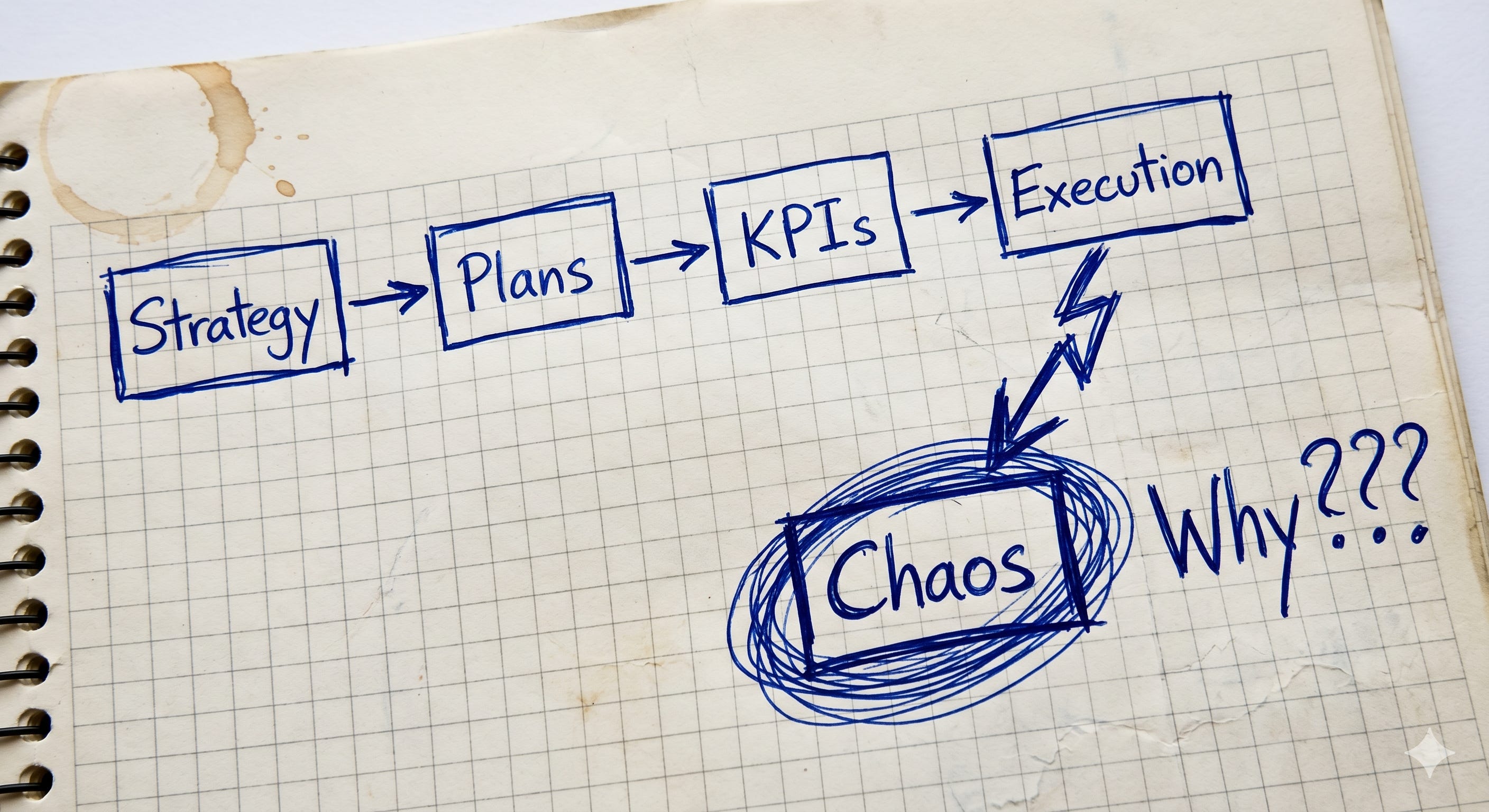
Most fires start even before the plans are put into action – right at the planning stage. And CEOs start these fires themselves, with their own hands.
Inside the Club today:
Three tools you use that DON’T help you
The hidden cause of ‘constant firefighting’
Improvements you can make in under a month
My new book about building an uncertainty-proof business is waiting for you!
About constant firefighting
A subscriber, let’s call her Susan, once wrote to me. “Hi S.B., I’ve been reading your newsletter for over a year. Thank you! I’m a CEO of a mid-size company, and I agree that strategy is important, but I don’t have time for it. I spend too much energy on constant firefighting. What should I do?”
We had a Zoom call. I said that as a former CEO myself, I understood her challenges well. We agreed that I would visit her office for three days to conduct an audit, find the roots of the problem, and suggest a solution.
As I suspected, the problem was not that Susan had “too many challenges”.
Three problems and three tools that DO NOT solve them
“Let me guess,” I suggested to Susan a month later, standing with a marker in front of a flip chart in her comfortable office in Asia. “You believe you have three types of problems.” I wrote them down on the flipchart:
Problem 1: Something always goes off-plan.
Problem 2: Unexpected things keep happening.
Problem 3: Your senior managers can’t handle these issues themselves and escalate everything to you.
Susan nodded.
“I bet you use three ways to solve them,” I said, turning back to the flipchart.
Solution 1: Plan more thoroughly.
Solution 2: Improve execution.
Solution 3: Put more pressure on senior and middle managers.
“Right?” I asked. Susan nodded again. “So, did it work?”
“No,” Susan shook her head. “Thorough planning only led to more bureaucracy, and putting pressure on the managers demotivated them.”
“That’s not surprising,” I said. “The first two problems are simply the result of a systemic error in strategic thinking. The third is down to a common planning mistake. Let’s set the third one aside for now and focus on the first two.” We’ll break down that third problem next Tuesday. Stay tuned!
Many CEOs are famous for finding the exit from any difficult situation. But they are even more famous for finding the entrance.
Hidden cause
“You can’t pour two litres of milk into a one-litre carton, right? Your problem is that you have too many tasks—more than you can handle. Some you set yourself, and others just hit you out of nowhere. The latter are your problems 1 and 2.” I drew a simple diagram on the flip chart:
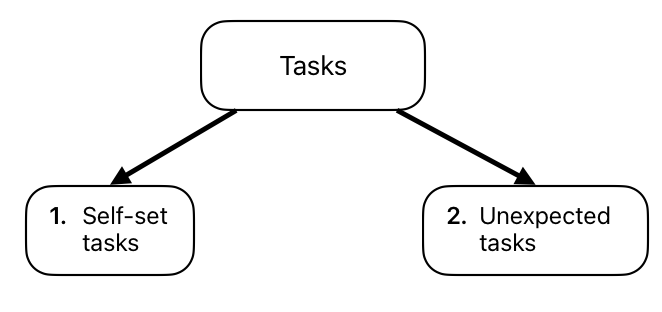
“You treat Part 1, your strategy and plans, as a sacred cow and pour all your energy into Part 2. But Part 2 is where you have the least control. You’re wasting resources trying to manage the unmanageable. It’s like fighting global warming by running the AC with the windows open.
“Unplanned problems are part of life, whether you like it or not. Those are the rules of the game. We overestimate our ability to predict the unexpected and keep everything on track. Remember the statistics I shared: only 0.5% of projects worldwide actually go exactly as planned.
“And you probably use the following logic when you plan,” I continued, drawing another diagram on the flip chart:

“This logic makes sense, but you only set priorities during the first phase—strategy. Then, once you dive into execution, you and your team forget them. So, the problem isn’t just that you have too many tasks; it’s that you lose track of which ones are more important.
“To be realistic, there are only three things we can do:
Get a bit better at handling the unexpected.
Prioritise constantly.
Reduce the number of self-set tasks.
“Wait a minute,” Susan protested. “Are you suggesting we cut our ambitious plans?”
“Someone who tries to run faster than they can stumbles, works harder, but ends up slower than the one who runs at a steady pace,” I replied.
“Chasing plans built on cognitive biases (more on this below) at any cost is like chasing a mirage. The price you pay is team burnout, a lack of resources, and—paradoxically—missed deadlines anyway. It is like taking a loan from the future at a massive interest rate. But you can work more productively, and we’ll discuss how next.
The CEO Lens: Run a Quick Test:
You feel burnt out yourself, and your team is too.
You work long hours, yet you still miss deadlines.
You spend more than 30% of your time on operational problems.
You have no time for strategy.
You constantly feel like you are missing something.
If you said “yes” at least twice, you likely have a problem. Einstein never actually said this, but it’s a great quote: “The first sign of insanity is doing the same thing over and over and expecting a different result.”
––
Our club is growing—we now have over 20,000 CEOs from all over the world. Thank you for your support and for valuing my work!
––
Hands-on Tactics for the CEO: Improvements You Can Make in Under a Month
Life doesn’t ruin our plans. We create plans that aren’t built for reality.
I turned the page of the flip chart and started writing on a fresh sheet.
“We are all victims of several cognitive biases:
We forget that strategy is about creating something new. We haven’t done it before, so our plans are only hypotheses.
We fall into the trap that Kahneman and Tversky called The Planning Fallacy. We are too optimistic about deadlines and resources—usually by at least 20%.
We think that if we are drowning in problems today, we’ll somehow sort them out by tomorrow and free up time for strategy. This isn’t true. Unplanned problems are part of life. They will be there tomorrow, and the day after.
We assume that if we set priorities during the planning stage, we will remember them every day.

“And what can I do in a practical sense?” Susan asked.
I went on writing:
Accept that you cannot plan perfectly. Treat your plans as hypotheses—especially the strategic ones. Rely more on OKRs than on KPIs.
Revisit your list of your value drivers. As a reminder, value drivers are the foundation of your strategy. They are the features of your product or service that make your company unique to your customers and drive your growth. Any project that builds a value driver must be a top priority. The rest? Not so much. As we discussed two weeks ago, print Value Drivers out and post them around the office.
Analyse the projects that have the biggest impact on your value drivers and take personal control of them.
Give lower priority to problems that threaten your current results. It is better to lose one game and win the championship than the other way around. Name a single deadline that Tesla hasn’t missed.
Review the full list of projects with your team. Set more realistic deadlines—increase your timelines by 20–30%. It is better to finish a project two months late than never.
Ask your team to find the “critical weaknesses” in every project—the elements that could break due to internal or external problems. Create backup plans and dedicate more resources to these specific areas.
Develop your navigational principles (we will discuss these next Tuesday).
Check your work calendar. Most CEOs are fully booked at least a week in advance. This is a big mistake. You should only book four days of your week. Leave eight working hours, one day, for unexpected tasks. Trust me—they will arrive sooner than you think.
And remember: while creating customers won’t solve every difficulty, it will make your organisation uncertainty-proof. Read more below.
Those three days I spent in Susan’s office were just the beginning. Susan and her team put a lot of effort into changing how they handle planning, and the results are great. I know this because I became Susan’s strategy adviser. I will share some of those results with you next week.
If your team is drowning in fires and your ‘Strategy’ box keeps leading straight to ‘Chaos’, it’s time for a Strategic Stress-Test. We’ll look at your current planning process, identify the hidden ‘fire-starters,’ and rebuild your workflow to include a 20% uncertainty buffer. I take on only two such audits per quarter to ensure deep focus. If you’re interested, just reply to this email.
We’ll dive deeply into the navigational strategic principles next Tuesday. Stay tuned!
My new book about building an uncertainty-proof business is waiting for you!
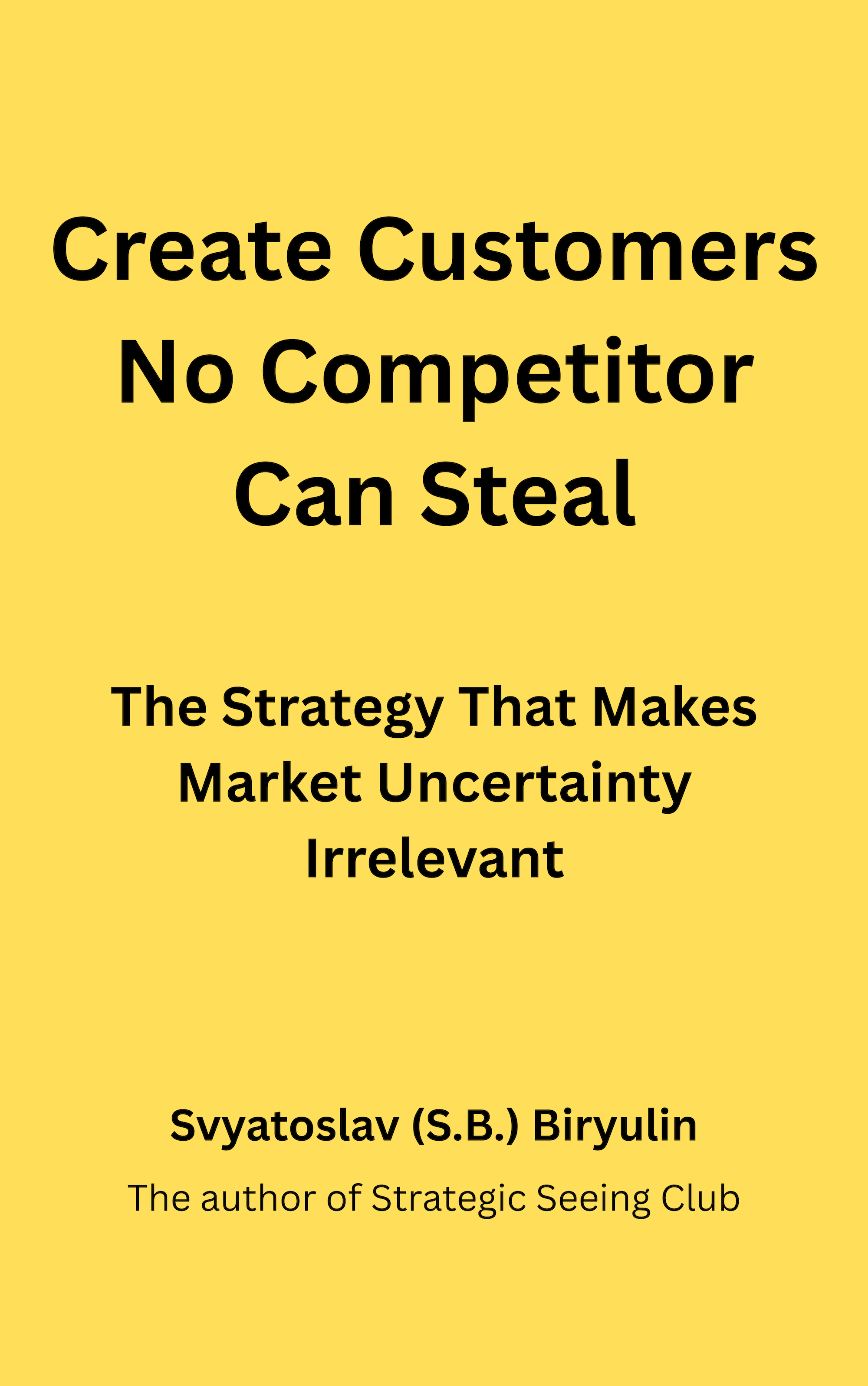
Last Friday, paid subscribers and founding members of this club received my new mini book: Create Customers No Competitor Can Steal: The Strategy That Makes Market Uncertainty Irrelevant.
This mini book is about how to make your organisation uncertainty-proof by creating unique customers—the kind that are very difficult for anyone else to take away. Free subscribers will be able to buy the book later, but paid members are already reading it!
You can easily join them—just upgrade to a paid subscription using the form below the picture, and the link to the book will be in your inbox within minutes. Read more about the book here.
I’m Svyatoslav (S.B.) Biryulin. I help mid-sized business CEOs globally build strategies for daily growth. I authored The Customer-Axis Framework and the ‘No Strategy Approach,’ focusing on Big Customer Problems and Growth Metabolism.
One of the hardest leadership shifts is accepting that “after this project” is often an illusion.
There is no final calm season where complexity disappears and leadership suddenly becomes easy.
Which means resilience comes less from eliminating uncertainty and more from designing systems that can absorb it without breaking people.
That’s a very different mindset from permanent firefighting.
Love this S.B. Thanks for sharing and thanks to Susan, for sharing as well.
I am curious it seems like delegated some authority to your team would be an important part of this as well, right?
Trying to get some of the decisions off your plate and letting your team problem solve a little bit. I’ve tried to do that more recently to help my work load. Working with my team to understand our goals and any limitations we have to him them. Then letting them run with it as they can, within boundaries.